Research Peptide Vial Labels and Lot Numbers: The Five Details I Never Skip
By Marcus Reid — Fri Sep 18 2026
Research Peptide Vial Labels and Lot Numbers: The Five Details I Never Skip — my honest, first-person take, backed by data from the 288 peptide vendors I track. Research use only.
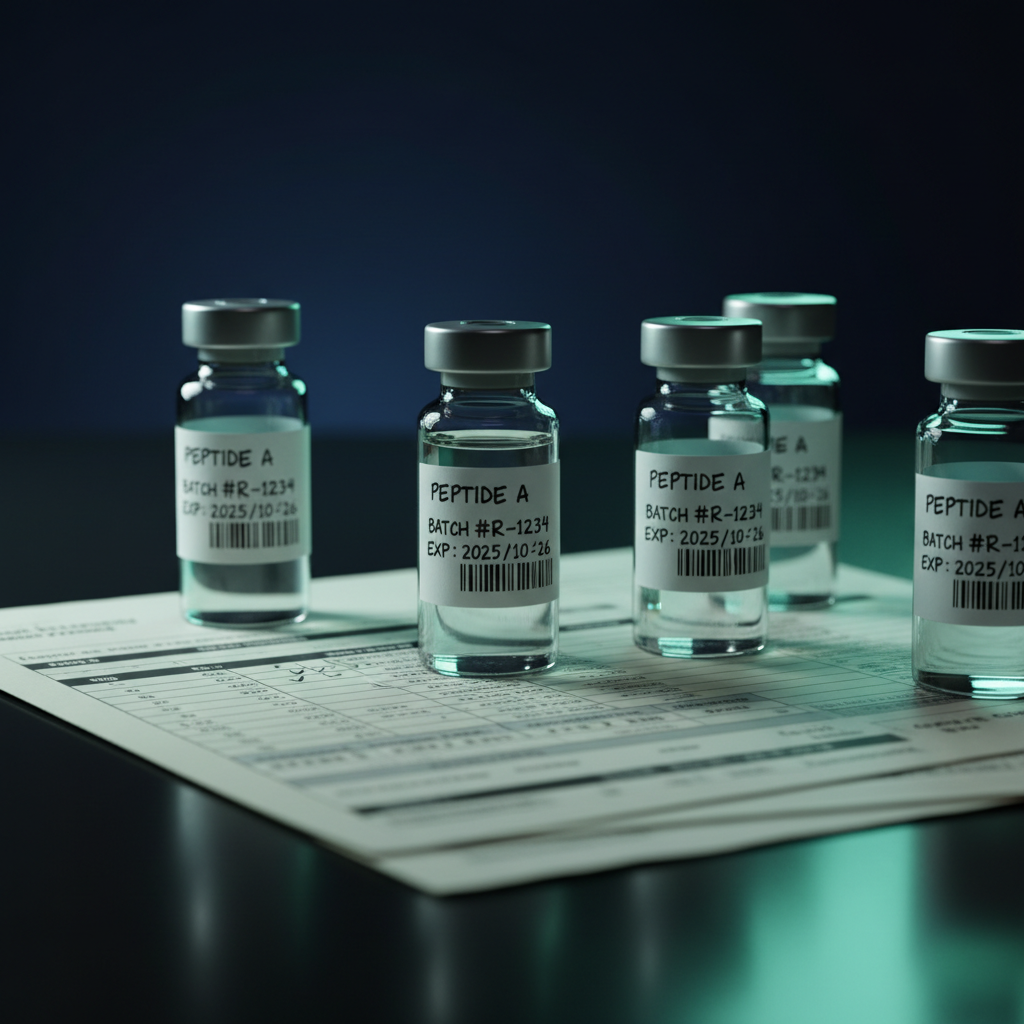
I still remember the first time a vial label contradicted the COA—I almost threw the sample out, then spent two frustrating days chasing a lot number that turned out to be a paperwork mix-up. Over the years I learned to treat the vial label and lot number as the first line of evidence, not the final word. Here's what I never skip when I handle a research peptide vial.
## Why the vial label and lot number matter more than you think A peptide vial label is often treated like an afterthought, but it’s a packed information card: catalog number, sequence shorthand, fill mass, solvent instructions, storage temperature, expiry and—most importantly—the peptide lot number. The lot number is the link between the physical vial and the COA, the QC run, and the manufacturer’s records. If that link is weak or missing, your "research peptide verification" workflow breaks down.
In my vendor database I track 288 vendor profiles. Only 23% (65 of 288) publish named-lab COAs—so for the majority of vendors the label and lot number are the clearest traceable evidence you have on receipt. Of the small subset that do have published editorial assessments, the average assessed rating is 4.70/5; one assessed vendor clears a 4.5/5 rating. Those numbers tell me: high-quality traceability is still the exception, not the rule.
## The five label-and-lot details I check immediately I run these checks in short order before I open the vial or reconstitute anything. They’re fast, concrete, and together they either validate the package or raise red flags worth documenting.
1. Exact sequence and catalog ID - I read the sequence printed on the label (three-letter code or full name) and match it against the catalog number. Mismatches happen—especially with salts, acetylations, or truncated forms. If the label lacks a clear sequence, I treat that as a problem until clarified.
2. Peptide vial label mass vs. what you ordered - The label should list net peptide mass (e.g., 5 mg lyophilized). I weigh the vial on a calibrated balance if the study depends on exact mass. Vendors sometimes report theoretical fill masses; I want the actual. If the reconstituted concentration depends on vial fill mass, don’t skip this.
3. Lot number and COA linkage - I locate the peptide lot number and immediately pull up the vendor’s COA (or ask for it). The lot number should match the COA batch ID. If there’s no COA online, I note the lot number and request a named-lab COA—especially since only 23% of vendors publish those; they’re a reliable differentiator when available.
4. Manufacturing/expiry dates and storage instructions - Manufacture date, expiry, and recommended storage (–20°C, –80°C, desiccant present) tell me whether that vial has been mishandled in transit or storage. If the label and COA show different storage temps, I escalate.
5. Label integrity and tamper signs - I inspect seal, cap, and label adhesion. A replaced label, residue, or shifted seal can indicate relabeling or repackaging. I document photos with the lot number visible before taking any corrective step.
## My short, practical checklist: the VIAL-5 Audit I use a simple named checklist that I find sticks in lab SOPs: the VIAL-5 Audit.
- V — Verify identifiers: catalog ID, sequence, CAS if provided. - I — Inspect mass & packaging: net mass, color, plug, desiccant. - A — Authenticate lot: match lot number to COA or vendor record. - L — Log storage: dates, temp, and transit conditions. - 5 — (Five-second) photo & record: photograph label + lot and upload to project folder.
Do this in five minutes. The photo plus a short note saves hours when you need traceability later.
## What I do when the lot number doesn’t match the COA Don’t panic. I follow a reproducible escalation path:
- Document: photograph label and COA side-by-side with timestamps. - Query: email vendor support with exact lot number, catalog number, and images. - Hold: set the vial aside and flag it in your inventory—don’t use it until clarified. - Request: ask explicitly for a named-lab COA for that lot or a statement explaining the discrepancy.
In my experience, many discrepancies are clerical. But I’ve also seen genuine mislabeling that required vendor recall—so treat every mismatch seriously.
## A counter-angle: stop treating vendor “purity” as the whole story Most guides insist purity numbers (HPLC area%, LC-MS spec) are the gold standard. I push back: purity is necessary information, but not sufficient for research peptide verification. Here’s why:
- Purity percentages rarely capture identity problems—an impurity peak could be a related peptide or an unrelated contaminant. - Different labs run different HPLC methods; a quoted “>95%” can be meaningless without method details. - A COA with excellent purity but no named lab or clear lot linkage is less useful than a modest-purity COA that includes identity confirmation and named-lab traceability.
So I always read purity numbers while insisting on a verifiable lot number–COA link and, where possible, an orthogonal identity test (MS1/HRMS trace or amino-acid analysis). If you only have a purity number from an anonymous COA, that’s a weak verification.
## Practical tips I use every week - Barcode or QR code? Scan it. Many vendors embed COA links behind QR codes tied to lot numbers. I save that URL with the lot photo. - Keep a vendor query template. A short, precise email asking for “COA for lot X, method details, and date of analysis” saves back-and-forth. - Use /peptides-list and /vendors to cross-check catalog IDs quickly. If you’re doing concentration math, the /peptide-calculator is the fastest way to reconcile label mass vs. reconstitution volume. - If a label omits fill mass but the catalog says 10 mg, ask for the net weight. Small discrepancies are often due to vial tare—large ones are not acceptable.
## When to refuse and when to accept with caution Refuse: missing lot number, no COA at all for a purchase where traceability matters, clear relabeling, or storage temperature violations shown by label/packaging.
Accept with caution: small discrepancies in fill mass that are documented and clarified, or lots from reputable vendors where the vendor provides quick, named-lab COAs to clear things up. Remember my baseline: only a minority of vendors publish named-lab COAs, so a vendor that does is already more traceable than most.
## Closing thought I treat the vial label and lot number as an audit trail rather than a stamp of absolute truth. When those pieces line up—catalog ID, lot number, COA, and packaging integrity—my confidence in the material rises dramatically. When they don’t, that’s often a signal to pause, document, and escalate. It’s tedious sometimes, but it’s saved me from bad data more than once.
*This content is for educational and research-use-only purposes. I am not a doctor; nothing here is guidance for human use.*
Frequently asked questions
What are the five label and lot-number details I never skip when I inspect a research peptide vial?
When I'm checking a peptide vial I always log these five things: the exact product name and sequence/identifier, the lot number and manufacturer, the concentration or amount listed on the vial, the manufacture/expiration dates (and any stated stability or storage conditions), and any COA or batch QC reference linked to that lot. I photograph the label, cross-reference the lot against the Certificate of Analysis, and record all five items in my lab notebook or LIMS so the sample stays traceable and reproducible. for educational and research-use-only purposes; this is not medical advice and no content should be treated as guidance for human use.
How do I verify a lot number and why does that step matter to my research?
I verify a lot number by matching the vial label to the supplier's documentation — the COA, packing slip, or the supplier's batch records — and, if needed, contacting the manufacturer for confirmation or archived QC data. I also check whether the lot has any reported deviations, recall notices, or atypical test results before I accept it into the study. That step matters because lot-to-lot variability, mislabeling, or a recalled batch can wreck reproducibility, invalidate data, and waste time and resources; keeping lot verification rigorous preserves traceability and scientific integrity. for educational and research-use-only purposes; this is not medical advice and no content should be treated as guidance for human use.
What's my routine for documenting and storing vial label and lot information so I never lose track?
My routine is simple and consistent: photograph the original vial label on receipt, upload the image and the supplier's COA into our LIMS or shared laboratory folder, and create a single-line entry in the lab notebook with the five key details (product/sequence, lot, amount, dates/storage notes, COA reference). I also label any aliquots with the lot and date, note the date received and freezer location, and log freeze–thaw counts or QC checks against that lot. If a lot looks suspicious I quarantine it and flag it for follow-up testing — documentation is the fastest way to troubleshoot later. for educational and research-use-only purposes; this is not medical advice and no content should be treated as guidance for human use.
References
About the author
Marcus Reid: Marcus Reid spent a decade in software engineering before going deep into peptide research, product documentation, and the clinical literature. He writes about what the data and the paperwork actually say. He is not a doctor; PeptideTally content is educational and does not constitute medical advice.