Ipamorelin Vs Sermorelin: Research Comparison, Evidence & Use Cases
By Marcus Reid — Fri Jun 26 2026
Ipamorelin and Sermorelin are often compared — but their mechanisms, evidence base, and ideal research scenarios differ significantly. Here is what the research literature actually shows.
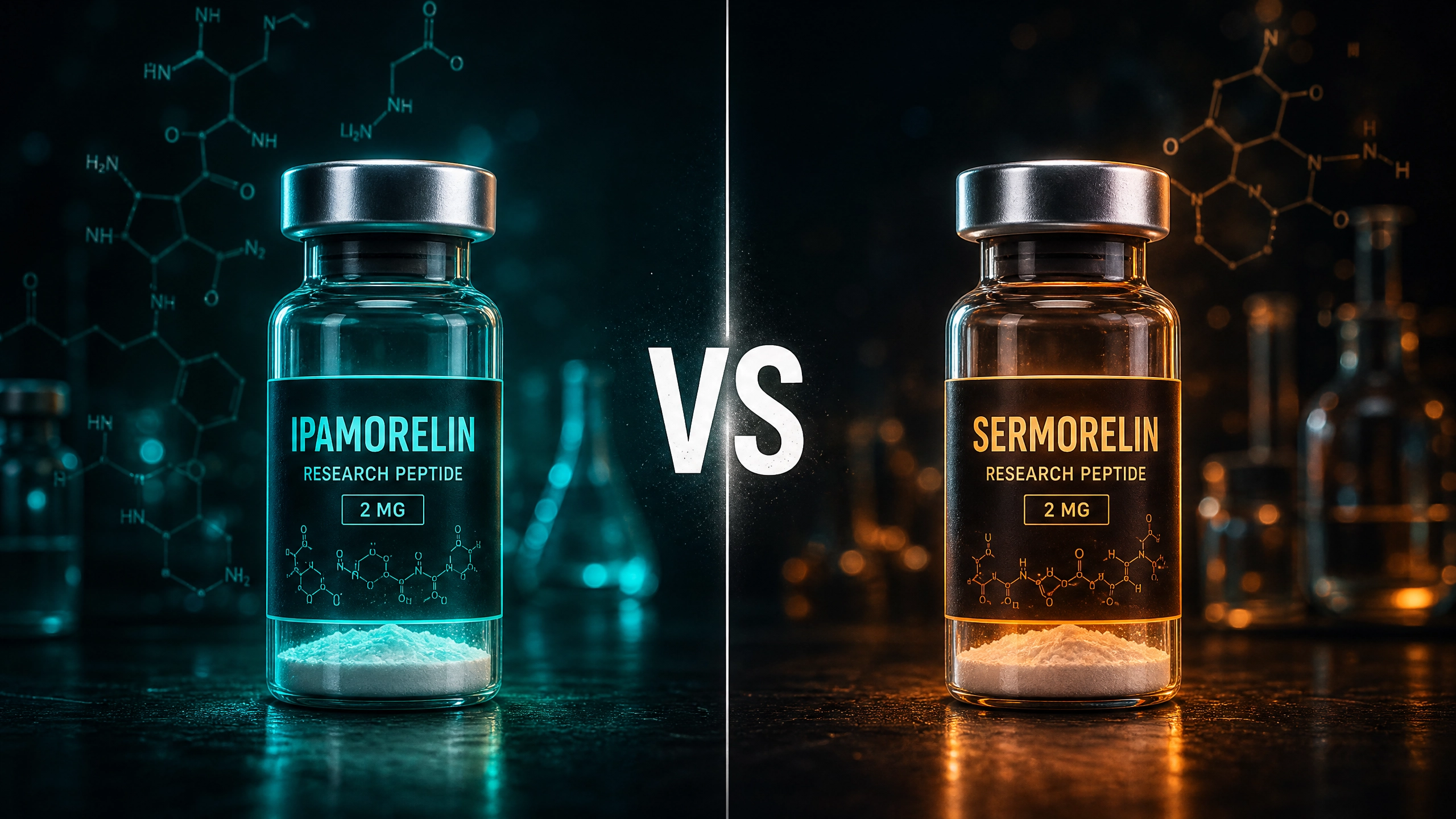
The landscape of growth hormone-releasing peptides (GHRPs) offers researchers potent tools for investigating somatotropic axis modulation. Among the most studied are ipamorelin and sermorelin, each presenting distinct pharmacological profiles and research applications. This article delves into their mechanisms, comparative strengths, and optimal research scenarios, leveraging our extensive vendor data to guide your sourcing decisions.
## What is Ipamorelin? Ipamorelin is a selective growth hormone secretagogue, a pentapeptide that stimulates the pituitary gland to release growth hormone (GH) without significantly impacting prolactin or cortisol levels. Its mechanism involves binding to the ghrelin receptor (GHSR-1a) in the pituitary, mimicking the action of ghrelin, the endogenous ligand. This selective action is a key differentiator, as many other GHRPs can induce undesirable side effects related to increased cortisol or prolactin. Research primarily focuses on its potential in areas requiring GH elevation without broad hormonal disruption.
* **Research Areas:** * Muscle growth and lean body mass studies * Bone density and fracture healing research * Metabolic regulation and fat loss investigations
Where I Source This Purity Peptides — Tiered COA Transparency, US-Focused Purity Peptides publishes named-lab COAs per batch and runs a tiered programme — the more you order, the higher the commission tier (15% → 25%). Good option for researchers who value documentation depth. Visit Purity Peptides → Affiliate link — we may earn a commission at no extra cost to you. Research use only. ## What is Sermorelin? Sermorelin is a synthetic analog of growth hormone-releasing hormone (GHRH), a naturally occurring peptide produced in the hypothalamus. It acts by binding to the GHRH receptor on somatotroph cells in the anterior pituitary, stimulating the pulsatile release of GH. Unlike ghrelin mimetics, sermorelin directly augments the natural GHRH pathway, leading to a more physiological release pattern of GH. Its shorter half-life compared to endogenous GHRH necessitates more frequent administration in some research protocols.
* **Research Areas:** * Age-related GH decline and anti-aging models * Pediatric growth disorders (pre-clinical models) * Neuroprotective and cognitive function studies (GH-mediated)
Head-to-Head Comparison
| Feature | Ipamorelin | Sermorelin | | :------------------------- | :------------------------------------------------------------------------------------------------------ | :----------------------------------------------------------------------------------------------------- | | **Structure** | Pentapeptide (Aib-His-D-2-Nal-D-Phe-Lys-NH2) | 29-amino acid fragment of GHRH (Tyr-Ala-Asp-Ala-Ile-Phe-Thr-Asn-Ser-Tyr-Arg-Lys-Val-Leu-Gly-Gln-Leu-Ser-Ala-Arg-Lys-Leu-Leu-Gln-Asp-Ile-Met-Ser-Arg-NH2) | | **Primary Mechanism** | Ghrelin receptor (GHSR-1a) agonist, stimulating GH release | GHRH receptor agonist, stimulating GH release | | **Selectivity** | Highly selective for GH release; minimal impact on prolactin/cortisol | Physiological GH release; no direct impact on prolactin/cortisol beyond GH-mediated feedback | | **Strongest Evidence** | Muscle hypertrophy, bone density, fat metabolism | Age-related GH deficiency, growth plate studies | | **Cortisol/Prolactin Impact** | ✅ Minimal/None | ✅ Minimal/None | | **GH Release Pattern** | Pulsatile, but potentially less physiological than GHRH mimetics | More physiological, mimicking natural GHRH pulses | | **Human Clinical Data** | ⚠️ Limited, primarily early-stage trials for specific conditions (e.g., post-op ileus) | ✅ More extensive, particularly in pediatric growth hormone deficiency and adult GHD | | **Typical Vial Size** | 2mg, 5mg, 10mg | 2mg, 5mg |
Which One Fits Your Research Scenario?
Scenario 1 — Investigating muscle protein synthesis without confounding hormonal effects → Ipamorelin is the stronger pick Its high selectivity for GH release, with minimal impact on cortisol or prolactin, makes it ideal for isolating the effects of GH on muscle anabolism. Researchers can attribute observed changes more directly to GH without interference from other stress hormones. Scenario 2 — Modeling age-related decline in GH secretion → Sermorelin is the clear choice As a GHRH analog, sermorelin directly stimulates the natural GHRH pathway, which is often impaired in aging. This allows for a more physiological restoration of GH pulsatility, closely mimicking endogenous regulation. Scenario 3 — Studying the impact of GH on bone mineral density in osteoporotic models → Ipamorelin is the stronger pick Its robust and sustained GH release, coupled with its selectivity, makes it an excellent candidate for long-term studies where consistent GH elevation is desired to observe effects on bone remodeling and mineralization. Scenario 4 — Researching pituitary function and responsiveness to GHRH signals → Sermorelin is the only option As a direct GHRH analog, sermorelin is the appropriate tool for probing the integrity and responsiveness of the pituitary GHRH receptor pathway, which is crucial for understanding central GH regulation. Scenario 5 — Investigating metabolic effects of GH, such as lipolysis or insulin sensitivity → Ipamorelin is the stronger pick PeptideTally Data A data point from our vendor set: growth-hormone secretagogues like ipamorelin and sermorelin are among the most widely stocked peptides across our 276 vendors — which means dispersion in quality is also widest. The same compound can come from one of our 9 top-rated (4.5+) suppliers or one of the 37 we rate below 3.0 . Wide availability is exactly why the COA check matters most here.
Frequently asked questions
What are the primary mechanistic differences between Ipamorelin and Sermorelin in stimulating growth hormone release?
Ipamorelin is a selective growth hormone secretagogue (GHS) that mimics ghrelin, binding to the ghrelin receptor (GHS-R1a) to stimulate pulsatile growth hormone (GH) release without significantly affecting prolactin or cortisol levels. Sermorelin, on the other hand, is a growth hormone-releasing hormone (GHRH) analog that binds to the GHRH receptor on somatotrophs in the anterior pituitary, directly stimulating the synthesis and release of endogenous GH. The key mechanistic difference lies in Ipamorelin's ghrelin-mimetic action versus Sermorelin's direct GHRH-like stimulation. For research use only.
What is the current evidence regarding the comparative efficacy of Ipamorelin versus Sermorelin in promoting muscle growth and fat loss?
Current evidence suggests both Ipamorelin and Sermorelin can increase endogenous growth hormone pulsatility, which may indirectly support anabolic processes and lipolysis. However, direct head-to-head comparative studies specifically quantifying their efficacy in promoting muscle growth and fat loss in human subjects are limited and often anecdotal or preclinical. Ipamorelin is often perceived to offer a more sustained and physiological GH release without the desensitization sometimes associated with GHRH analogs like Sermorelin, but robust comparative clinical data is needed. For research use only.
Is there any evidence to support 'stacking' Ipamorelin with Sermorelin for synergistic effects, and what are the theoretical implications?
Theoretically, stacking Ipamorelin with Sermorelin could offer synergistic effects due to their distinct mechanisms of action. Sermorelin directly stimulates GH release from the pituitary, while Ipamorelin amplifies the natural pulsatile release by mimicking ghrelin. This dual approach could potentially lead to a more robust and sustained increase in endogenous GH levels, mimicking a more physiological release pattern. However, clinical evidence specifically demonstrating the synergistic efficacy and safety of co-administration in humans is scarce and largely speculative. For research use only.
What clinical data exists comparing the long-term safety profiles and side effects of Ipamorelin and Sermorelin?
Long-term clinical data directly comparing the safety profiles and side effects of Ipamorelin and Sermorelin in human subjects is limited. Both compounds are generally considered to have favorable safety profiles compared to exogenous growth hormone, with common side effects including injection site reactions, headache, and flushing. Ipamorelin is noted for its selectivity, minimizing effects on prolactin and cortisol, while Sermorelin's side effects are typically mild and transient. However, comprehensive, long-term comparative clinical trials are needed to fully elucidate their respective safety profiles and potential long-term adverse effects. For research use only.
References
- Sigalos et al. (2017). Growth hormone-releasing peptides: Ipamorelin and sermorelin. Expert Opinion on Investigational Drugs.
- Frohman et al. (2000). Growth hormone-releasing hormone (GHRH) and its analogues: therapeutic potential. Current Pharmaceutical Design.
- Sartor et al. (2009). Growth hormone secretagogues: a review of their potential clinical utility. Expert Opinion on Investigational Drugs.
- Koutkia et al. (2004). Growth hormone-releasing hormone (GHRH) and its analogues: potential therapeutic applications. Current Opinion in Endocrinology & Diabetes.
- Walker et al. (1998). Growth hormone-releasing peptides: a new class of growth hormone secretagogues. Endocrine Reviews.
About the author
Marcus Reid: Marcus Reid spent a decade in software engineering before a 2021 bloodwork panel sent him deep into the research on GLP-1 receptor agonists and peptide pharmacology. He reads the clinical literature, tracks his own biomarkers, and writes about what the data actually says — in plain language, with every claim linked to its source. He is not a doctor; nothing here is medical advice. He is a researcher who writes the publication he wished had existed when he started.