How Much Peptide Should I Take? What the Research Literature Actually Reports
By Marcus Reid — Sun Jun 21 2026
"How much peptide should I take?" is the most common question researchers ask — but the honest answer is more nuanced than a single number. Here is how the research literature actually frames quantity.
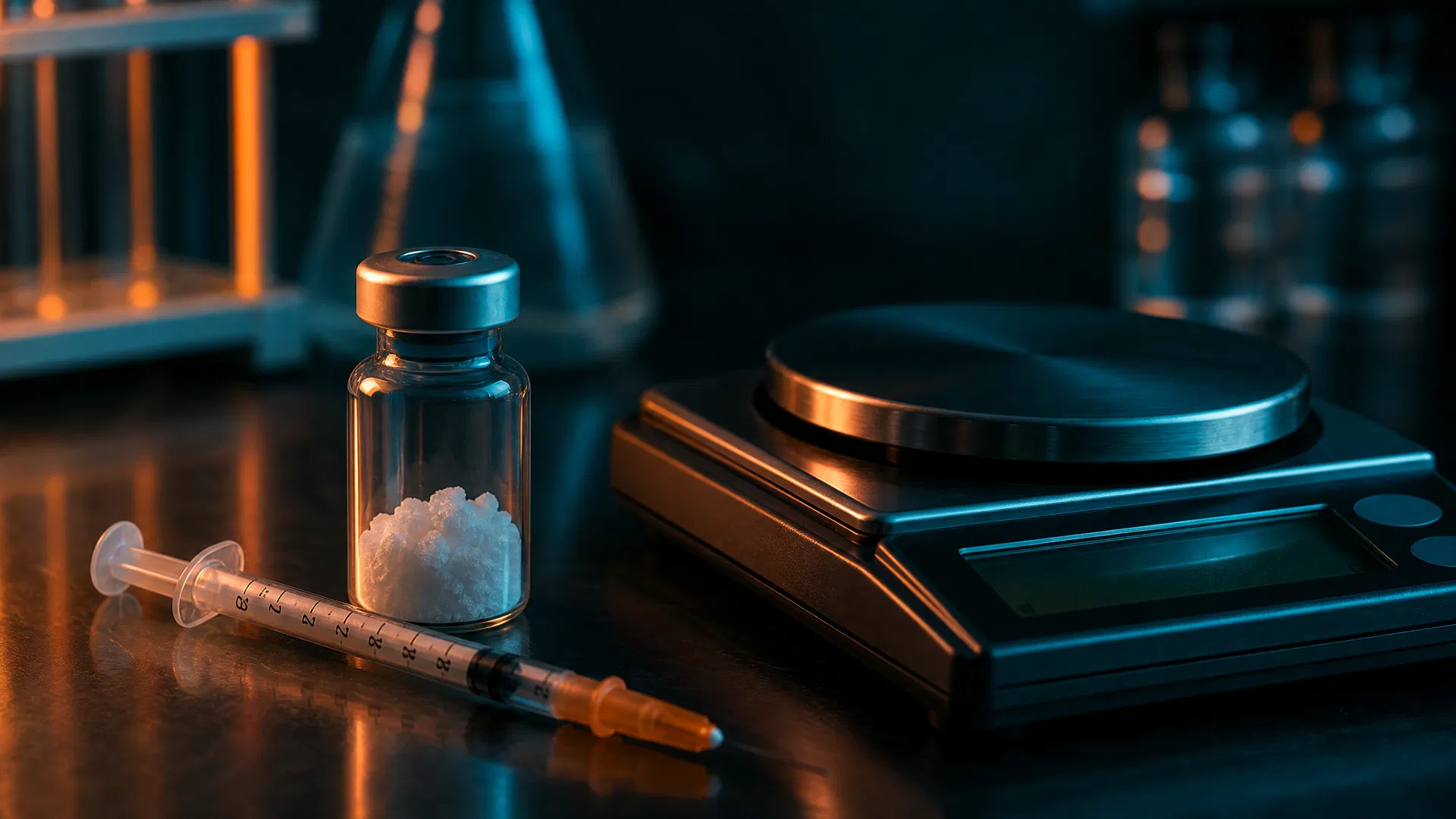
If you have spent any time reading research forums, you have seen the question a hundred times: *how much peptide should I take?* It is the first thing almost everyone wants to know, and it is also the question with the least satisfying answer. There is no universal number, and anyone who hands you one without context is guessing. What the published research actually describes is far more specific — tied to a particular compound, a particular model, and a particular study design.
This guide is written strictly for research-use-only context. None of the compounds discussed here are approved for human consumption, and nothing below is a dosing instruction. Instead, we will walk through how quantity is framed in the literature, why it varies so widely, and what you should verify before you even think about the number.
Why there is no single answer
Peptides are not interchangeable. BPC-157, Ipamorelin, CJC-1295, GHK-Cu and MOTS-c are structurally different molecules that behave differently in research models. A quantity described in one study tells you almost nothing about another compound. Even within a single peptide, the literature reports a wide range depending on whether the study used a cell model, a rodent model, or a different species entirely.
That is why the phrase "how much peptide should I take" is the wrong starting question. The better question is: *what does the research on this specific compound actually report, and how was that quantity measured?*
The factors that change the number
When you read a methods section in a peer-reviewed paper, the reported quantity is never a standalone figure. It is always attached to several variables:
| Factor | Why it matters | | --- | --- | | Compound identity | Each peptide has a different molecular weight and behavior | | Research model | Cell culture, rodent, and other models are not comparable | | Concentration & purity | A 99% pure compound and a 70% compound are different inputs | | Reconstitution volume | The same mass in different volumes changes concentration | | Study endpoint | What the researchers were measuring shapes the protocol |
Notice that purity sits right in the middle of that table. This is the part most people skip — and it is the part that makes the "how much" question almost meaningless if you cannot answer it. If you do not know what is actually in the vial, the quantity printed on the label is just a marketing claim.
Start with the certificate of analysis, not the number
Before quantity is even worth discussing, you need to know the vial contains what it claims. That is the entire job of a [certificate of analysis](https://en.wikipedia.org/wiki/Certificate_of_analysis) (COA). A batch-specific COA from a named third-party laboratory, using [HPLC](https://en.wikipedia.org/wiki/High-performance_liquid_chromatography) for purity and mass spectrometry for identity, is the only way to confirm you are working with the compound you think you are.
A vendor that publishes public, batch-specific COAs is giving you the one piece of information that makes a research quantity reproducible. A vendor that says "COA available on request" or relies on in-house testing only is asking you to take the number on faith. You can compare which vendors publish verifiable COAs in our [vendor comparison table](/).
Reconstitution: the step that quietly changes everything
Most research peptides ship as a lyophilized (freeze-dried) powder. Before anything happens, that powder is reconstituted with bacteriostatic water. The volume of water you add determines the concentration of the resulting solution — and this is where a huge amount of confusion enters.
The same 5 mg of peptide reconstituted in 1 mL versus 2 mL produces two very different concentrations. So when a study or a vendor references a quantity, it is only meaningful alongside the reconstitution detail. A quantity without a concentration is an incomplete instruction, and incomplete instructions are how research goes wrong.
How researchers actually approach it
In a properly documented study, the team does not start with "how much." They start with the hypothesis, choose a model, then derive the quantity from prior literature on that exact compound and model. The number is the *output* of a careful process, not the input. The discipline of working backward from published, peer-reviewed sources — rather than forward from a forum post — is what separates reproducible research from guesswork.
If you are designing research, the credible path is to read the methods sections of primary sources on [PubMed](https://pubmed.ncbi.nlm.nih.gov/) for your specific compound, note the model and concentration alongside every quantity, and treat any single number stripped of its context as unreliable.
The honest bottom line
So, how much peptide should you take? For research purposes, the answer is always: *it depends on the compound, the model, the purity, and the concentration — and you cannot responsibly answer it until you have verified the vial against a third-party COA.* The number everyone wants is the last thing you should settle, not the first.
If you are still choosing a supplier, start there. A vendor with verifiable purity makes every downstream quantity meaningful; a vendor without one makes all of them suspect. Take our [60-second vendor quiz](/quiz) to find a research-grade supplier matched to your priorities, or browse the full [vendor comparison table](/) to see who publishes batch-specific COAs.
PeptideTally Data A practical note from our dataset: research measurement accuracy depends entirely on the stated concentration being real. When we reviewed COA practices across our 276 tracked vendors , only 21% publish named-lab purity data — meaning for most suppliers, the "mg per vial" on the label is unverified. Any measurement calculation is only as accurate as the vial behind it, which is why we weight COA transparency above every other scoring factor.
Frequently asked questions
Is there a standard peptide quantity for research?
No. Quantities reported in the literature are always specific to a compound, a research model, and a concentration. There is no universal figure, and any single number presented without that context is unreliable.
Why does purity matter for quantity?
If a vial is not the purity it claims, the quantity on the label does not reflect how much active compound is actually present. A third-party COA is what makes a quantity meaningful.
What is reconstitution?
Most research peptides are freeze-dried powders that must be dissolved in bacteriostatic water before use. The volume of water added determines the concentration, which is inseparable from any quantity discussion.
Are these compounds approved for human use?
No. The peptides discussed are sold strictly for research use only and are not approved for human consumption.
References
About the author
Marcus Reid: Marcus Reid spent a decade in software engineering before a 2021 bloodwork panel sent him deep into the research on GLP-1 receptor agonists and peptide pharmacology. He reads the clinical literature, tracks his own biomarkers, and writes about what the data actually says — in plain language, with every claim linked to its source. He is not a doctor; nothing here is medical advice. He is a researcher who writes the publication he wished had existed when he started.