Glow Vs Klow: Research Comparison, Evidence & Use Cases
By The PeptideTally Research Team — Thu Jul 02 2026
Glow (Melanotan II) and klow (PT-141 / Bremelanotide) are related melanocortin compounds with distinct receptor profiles and very different evidence tiers. One has FDA approval; the other has stronger pigmentation data. Here is the full comparison.
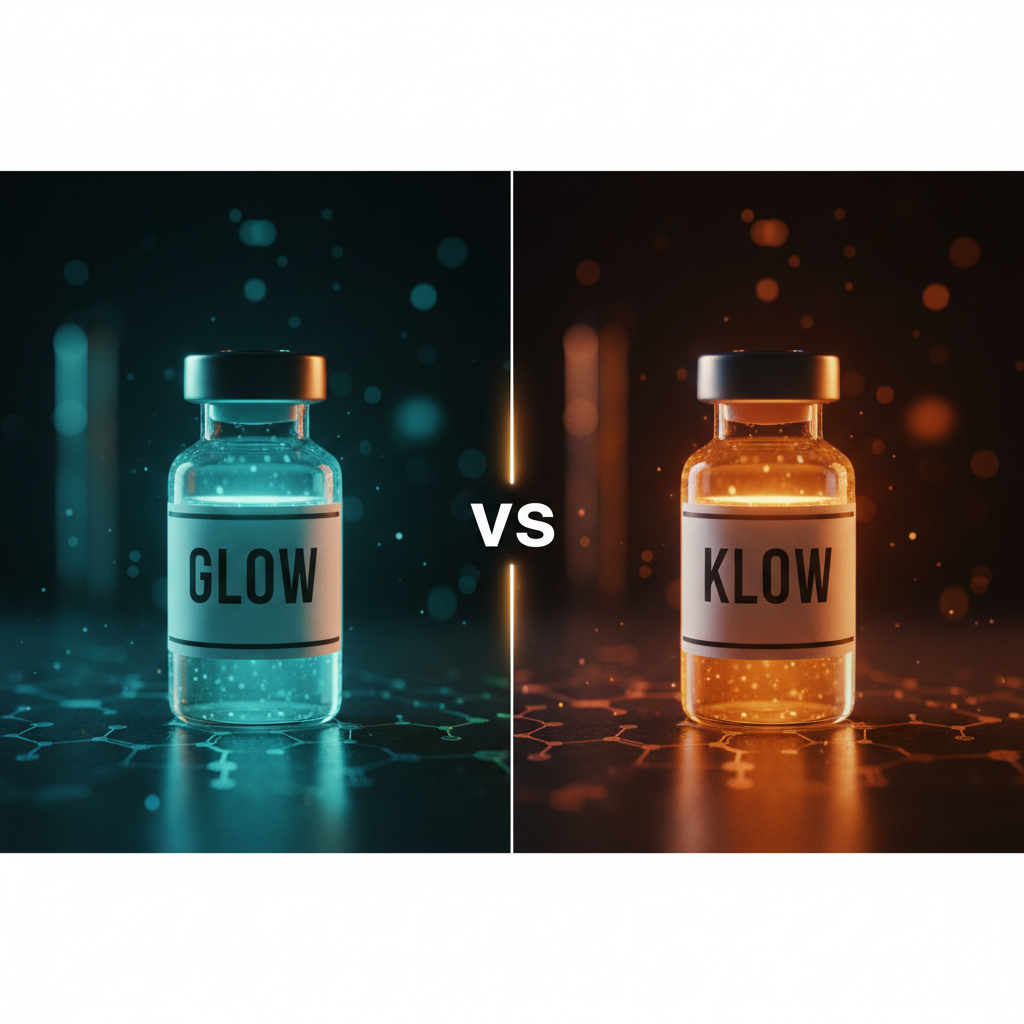
"Glow" and "klow" are informal community names for two distinct research peptides: **Melanotan II** (glow) and **PT-141 / Bremelanotide** (klow). They are structurally related — both are synthetic analogues of alpha-melanocyte-stimulating hormone (α-MSH) — but their research profiles diverge significantly. One is studied primarily for skin pigmentation effects; the other for a different receptor-mediated pathway. This guide breaks down the mechanisms, evidence, and sourcing realities side by side.
**Research use only.** All compounds discussed here are intended strictly for laboratory and research use. Nothing in this article is medical advice, and these compounds are not approved for general human consumption.
What is glow (Melanotan II)?
Melanotan II (MT-II) is a cyclic lactam analogue of α-MSH. It acts as a non-selective agonist at melanocortin receptors MC1R, MC3R, MC4R, and MC5R. Its primary research interest has been in two areas: skin pigmentation (via MC1R activation, which stimulates melanin production) and appetite/energy regulation (via MC4R).
The three areas where Melanotan II's research is most documented:
- **Skin pigmentation** — MC1R-mediated melanogenesis; the compound's most studied effect in rodent and human models - **Appetite suppression** — MC4R activation in the hypothalamus; studied in obesity models - **Broad receptor profile** — its non-selectivity means it produces multiple simultaneous effects, which complicates research interpretation
Where I Source This Purity Peptides — Tiered COA Transparency, US-Focused Purity Peptides publishes named-lab COAs per batch and runs a tiered programme — the more you order, the higher the commission tier (15% → 25%). Good option for researchers who value documentation depth. Visit Purity Peptides → Affiliate link — we may earn a commission at no extra cost to you. Research use only. ## What is klow (PT-141 / Bremelanotide)?
PT-141, also known as Bremelanotide, is a metabolite of Melanotan II. It is a cyclic peptide that acts primarily on MC4R and MC3R, with less activity at MC1R than Melanotan II. This selectivity shift means it has a different research profile.
PT-141 has the strongest translational evidence of the two: it received FDA approval in 2019 as Vyleesi for hypoactive sexual desire disorder in premenopausal women, making it the only melanocortin-based compound with a completed approval pathway.
The three areas where PT-141's research is most established:
- **MC4R-mediated pathways** — more selective than Melanotan II; the basis for its distinct research profile - **FDA-approved indication** — Vyleesi (bremelanotide) is the only approved melanocortin compound - **Cardiovascular considerations** — clinical trials documented transient blood pressure effects, which is a key differentiator from Melanotan II
Head-to-Head Comparison
| Feature | glow (Melanotan II) | klow (PT-141 / Bremelanotide) | |---|---|---| | **Common name** | Melanotan II, MT-II | PT-141, Bremelanotide | | **Structure** | Cyclic α-MSH analogue | Melanotan II metabolite | | **Receptor selectivity** | MC1R, MC3R, MC4R, MC5R | Primarily MC3R, MC4R | | **Skin pigmentation effect** | ✅ Strong (MC1R) | ⚠️ Minimal (low MC1R activity) | | **Evidence tier** | Rodent models + some human | ✅ FDA-approved (Vyleesi) | | **Human clinical data** | Limited | ✅ Phase III completed | | **Half-life** | ~1-2 hours | ~2-3 hours | | **Synthesis difficulty** | Moderate | Moderate | | **Typical vial size** | 10 mg | 10 mg | | **Vendor availability** | Widely stocked | Widely stocked |
Which One Fits Your Research Scenario?
Scenario 1 — Melanogenesis and pigmentation research → Melanotan II (glow) is the relevant compound MC1R activation is the primary driver of melanogenesis. Melanotan II has much stronger MC1R activity than PT-141 and is the standard compound in pigmentation research. Scenario 2 — Translatable, clinically-grounded research → PT-141 (klow) has the stronger evidence base PT-141 is the only melanocortin compound with FDA approval and completed Phase III trials. If translatability to documented human outcomes matters, the evidence tier is unambiguous. Scenario 3 — MC4R pathway research → PT-141 (klow) is the more selective tool PT-141 has greater MC4R selectivity than Melanotan II. For research specifically targeting MC4R-mediated pathways, the more selective compound produces cleaner results. Scenario 4 — Appetite and energy regulation models → Both are studied; Melanotan II has more rodent data Both compounds act on MC4R, which is involved in energy homeostasis. Melanotan II has a longer rodent-model track record in this context. Scenario 5 — Cardiovascular safety profiling → PT-141 (klow) has the documented clinical data PT-141 clinical trials documented transient blood pressure effects. This clinical characterisation makes it the better-understood compound for cardiovascular-adjacent research.
Can They Be Used Together?
Rarely combined in research, because they act on overlapping receptors. Stacking two melanocortin agonists provides little additive benefit and increases receptor saturation without a clear mechanistic rationale. PT-141 is itself a metabolite of Melanotan II, so the two share significant pharmacological overlap. Research protocols typically choose one based on the specific receptor profile required.
PeptideTally Data Both Melanotan II and PT-141 are among the most widely stocked compounds across our 276 tracked vendors — which means quality dispersion is also widest. Of those 276 vendors, only 59 (21%) publish COAs from a named or third-party lab. For melanocortin compounds specifically, where synthesis errors can be difficult to detect by purity alone, LC-MS identity confirmation is the differentiating quality signal.
Sourcing: What to Look For
For either compound, demand HPLC purity data from a named third-party laboratory. For Melanotan II specifically, LC-MS identity confirmation is worth prioritising because it is one of the most frequently counterfeited research peptides. Cross-reference any supplier against our [full vendor comparison table](/vendors), which ranks all 276 vendors on COA transparency, purity, pricing and shipping.
*All products referenced in this article are intended strictly for laboratory and research use only. Nothing in this article constitutes medical advice, diagnosis, or treatment. These compounds are not approved by the FDA for general human consumption. Always consult a qualified healthcare professional before handling any research chemical.*
Frequently asked questions
What is the difference between glow (Melanotan II) and klow (PT-141)?
Glow refers to Melanotan II, a non-selective melanocortin receptor agonist with strong MC1R activity studied for skin pigmentation. Klow refers to PT-141 (Bremelanotide), a Melanotan II metabolite with greater MC4R selectivity and FDA approval for a specific indication. Both are for research use only.
Which has more human clinical evidence, Melanotan II or PT-141?
PT-141 (Bremelanotide / klow) has significantly more human clinical evidence — it received FDA approval in 2019 as Vyleesi following completed Phase III trials. Melanotan II has limited human data. Both are for research use only.
Can Melanotan II and PT-141 be stacked?
There is little research rationale to combine them — PT-141 is a metabolite of Melanotan II and both act on overlapping melanocortin receptors. Stacking provides minimal additive benefit. All for research use only.
Why is Melanotan II called 'glow' and PT-141 called 'klow'?
These are informal community nicknames used in research peptide forums. Glow refers to Melanotan II's skin pigmentation research profile (MC1R activation). Klow refers to PT-141's distinct receptor profile. Neither name has scientific or regulatory standing.
Which compound is better for MC4R research?
PT-141 (klow) has greater MC4R selectivity than Melanotan II, making it the more targeted tool for MC4R-specific research. Melanotan II's broader receptor activity introduces more variables. Both are for research use only.
References
- Dorr RT et al. (1996). Evaluation of melanotan-II, a superpotent cyclic melanotropic peptide in a pilot phase-I clinical study. Life Sciences.
- Rosen RC et al. (2004). Bremelanotide: an overview of preclinical CNS effects on female sexual function. Journal of Sex & Marital Therapy.
- Clayton AH et al. (2016). Bremelanotide for female sexual dysfunctions in premenopausal women. Obstetrics & Gynecology.
- King SH et al. (2007). Melanocortin receptors, melanotropic peptides and penile erection. Current Topics in Medicinal Chemistry.
- Wikberg JE (1999). Melanocortin receptors: perspectives for novel drugs. European Journal of Pharmacology.
- FDA (2019). Vyleesi (bremelanotide) approval. FDA Drug Approvals Database.
About the author
The PeptideTally Research Team: The PeptideTally Research Team independently scores and tracks 276 research-peptide vendors on purity, COA transparency, pricing and shipping. All comparisons draw on our own vendor dataset. Research use only.