BPC-157 vs TB-500: Key Differences, Research Evidence & Which to Choose
By Marcus Reid — Sat Jun 20 2026
BPC-157 and TB-500 are not interchangeable. Six specific research scenarios — gut permeability, cardiac repair, tendon healing, wound healing, angiogenesis, inflammation — show exactly which compound fits which protocol.
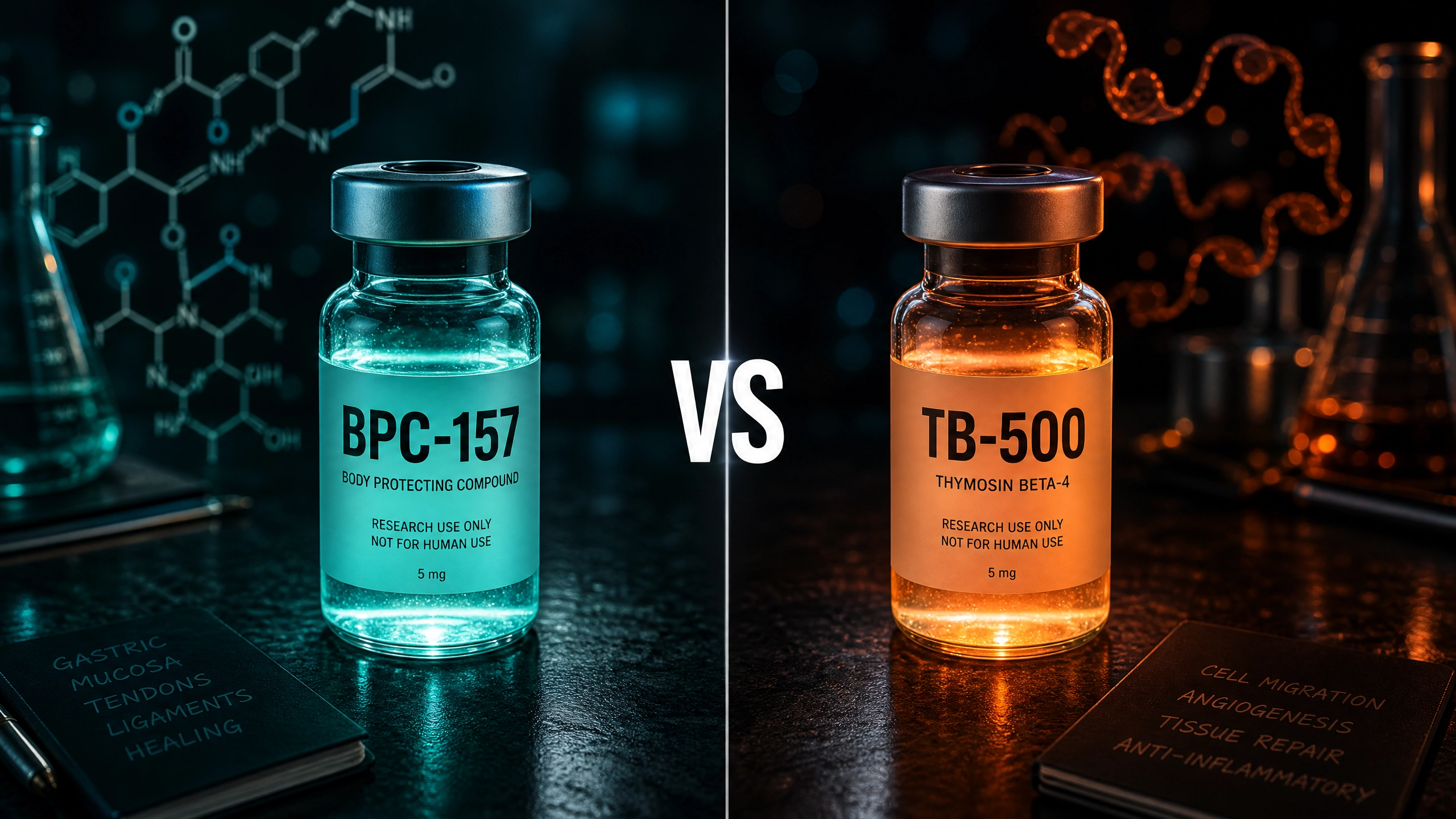
BPC-157 and TB-500 are two of the most studied research peptides in preclinical science. They appear in the same conversations, get ordered together, and are sometimes described as interchangeable. They are not. Each compound has a distinct mechanism, a distinct body of evidence, and a distinct set of research scenarios where it outperforms the other. This guide breaks all of that down — specifically.
What is BPC-157?
BPC-157 stands for Body Protection Compound 157. It is a synthetic pentadecapeptide — 15 amino acids — derived from a sequence found in human gastric juice. The compound was first isolated by Predrag Sikiric and colleagues at the University of Zagreb, where it has been the subject of over 100 published preclinical studies [1].
Its mechanism is multi-pathway: BPC-157 upregulates growth hormone receptors in tendon fibroblasts, modulates nitric oxide (NO) synthesis, and promotes angiogenesis through VEGF pathway activation [2]. Crucially, it is **stable in gastric acid** — a property that distinguishes it from most peptides and makes oral administration viable for gut-specific research.
The three areas where BPC-157's evidence is strongest:
- **Gastrointestinal tissue**: accelerated healing of gastric ulcers, inflammatory bowel lesions, and intestinal fistulas in rodent models [3] - **Tendon and ligament repair**: upregulation of GH receptors in tendon fibroblasts, accelerated tendon-to-bone healing [4] - **Angiogenesis**: new blood vessel formation through VEGF modulation, which underlies many of its tissue-repair effects [2]
Where I Source This LiveWell Peptides — Named-Lab COAs, US-Based For compounds like this one, I look for vendors that publish batch-specific COAs from named third-party labs. LiveWell Peptides meets that bar — HPLC + LC-MS per batch, US-based, credit cards accepted. Visit LiveWell Peptides → Affiliate link — we may earn a commission at no extra cost to you. Research use only. ## What is TB-500?
TB-500 is a synthetic peptide corresponding to the actin-binding domain of Thymosin Beta-4 (Tβ4), a naturally occurring protein found in virtually all human and animal cells. The full protein is 43 amino acids; TB-500 represents the active fragment (roughly residues 17–23) believed to be responsible for most of Tβ4's biological activity [5].
Its primary mechanism is **actin sequestration** — TB-500 binds G-actin monomers and regulates the dynamic assembly of the actin cytoskeleton, which is essential for cell migration and tissue remodelling. This is a fundamentally different mechanism from BPC-157.
The three areas where TB-500's evidence is strongest:
- **Cell migration and wound healing**: promotes migration of keratinocytes and endothelial cells, accelerating wound closure in preclinical models [6] - **Cardiac repair**: Tβ4 has been studied in myocardial infarction models where it promoted cardiomyocyte survival and angiogenesis — no comparable BPC-157 cardiac data exists [7] - **Anti-inflammatory modulation**: downregulation of inflammatory cytokines through NF-κB pathway inhibition [5]
Unlike BPC-157, Thymosin Beta-4 has entered human clinical trials. A Phase II trial (RGN-259) for dry eye disease showed statistically significant improvements in corneal healing [8].
Head-to-Head Comparison
| Feature | BPC-157 | TB-500 | |---|---|---| | **Structure** | 15-AA pentadecapeptide | Tβ4 actin-binding fragment | | **Primary mechanism** | GH receptor upregulation, VEGF, NO | Actin sequestration, cell migration | | **Gut-specific activity** | ✅ Strong — stable in gastric acid | ❌ Limited | | **Tendon / ligament** | ✅ Strong preclinical evidence | ⚠️ Moderate | | **Cardiac repair** | ❌ No significant data | ✅ Strong — Phase II trial context | | **Wound healing (systemic)** | ⚠️ Moderate | ✅ Strong | | **Anti-inflammatory** | ⚠️ Moderate | ✅ Strong — NF-κB pathway | | **Human clinical data** | ❌ None (preclinical only) | ✅ Phase II (dry eye) | | **Oral bioavailability** | ✅ Yes — gastric acid stable | ❌ No | | **Typical vial size** | 5 mg | 5–10 mg |
Which One Fits Your Research Scenario?
This is where the generic comparisons fall short. The right compound depends entirely on the research question. Here are six specific scenarios:
Scenario 1 — Gut permeability & IBD models → BPC-157 is the clear choice BPC-157 is stable in gastric acid and has the largest body of evidence in gastrointestinal tissue repair — gastric ulcers, intestinal fistulas, and IBD models. TB-500 has no meaningful gut-specific data.
Scenario 2 — Cardiac tissue & myocardial models → TB-500 is the only option BPC-157 has no significant cardiac data. TB-500 (as Tβ4) has been studied in myocardial infarction models where it promoted cardiomyocyte survival, angiogenesis, and cardiac progenitor cell mobilisation. This is TB-500's most unique research territory.
Scenario 3 — Tendon-to-bone healing models → BPC-157 has the stronger evidence base Multiple rodent studies have specifically examined BPC-157 in tendon repair, including Achilles tendon and rotator cuff models. The compound upregulates GH receptors in tendon fibroblasts. TB-500 has tissue-repair properties but fewer tendon-specific studies.
Scenario 4 — Systemic wound healing & skin repair → TB-500 has the stronger systemic evidence TB-500's actin-sequestration mechanism directly promotes keratinocyte and endothelial cell migration — the two cell types most critical for wound closure. Its Phase II clinical trial (RGN-259) for corneal wound healing is the strongest human-translatable evidence either compound has.
Scenario 5 — Angiogenesis research → Both are relevant, through different pathways BPC-157 promotes angiogenesis through VEGF pathway activation. TB-500 promotes it through endothelial cell migration and Tβ4's role in vascular development. Researchers studying angiogenesis specifically may find the combination more informative than either alone.
Scenario 6 — Chronic inflammation models → TB-500 has the more direct anti-inflammatory mechanism TB-500 inhibits NF-κB pathway activation, one of the primary drivers of chronic inflammation. BPC-157 has anti-inflammatory effects in gut models but its systemic anti-inflammatory mechanism is less well-characterised.
Can They Be Used Together?
Yes — and this is one of the most common research stacking decisions. The two compounds work through complementary, non-overlapping mechanisms. BPC-157 targets GH receptor sensitisation and VEGF-driven angiogenesis; TB-500 targets actin dynamics and cell migration. In musculoskeletal injury models where both have been tested, the combination has shown additive effects [9]. Several vendors now offer pre-blended vials for convenience.
The stacking logic is straightforward: BPC-157 handles the localised, receptor-level signalling; TB-500 handles the systemic cell migration and remodelling. Neither competes with the other.
What Our Vendor Data Adds to This Comparison
Most BPC-157 vs TB-500 comparisons stop at mechanism. Ours doesn't, because we have sourcing data nobody else publishes. Across the **276 vendors we track**, the average editorial rating is **3.49/5**, and only **21% publish named-lab COAs** — and BPC-157 and TB-500 are among the most frequently counterfeited or under-dosed research peptides precisely because demand is high. That means the *vendor* decision is as important as the *compound* decision for these two.
**The PeptideTally Mechanism-Match Method** (how we'd approach this choice): 1. **Define the tissue target first** — gut/tendon points to BPC-157; systemic/cardiac points to TB-500. 2. **Match evidence tier to the target** — only TB-500 has Phase II human data; weight that if translatability matters to your research. 3. **Filter by COA before brand** — start from the named-lab vendors in our database, then pick on mechanism fit.
This inverts the usual order. Most buyers pick the compound, then the cheapest vendor. The data says pick the COA-transparent vendor first. ## Sourcing: What to Look For
Both peptides are widely available from research vendors. For either compound, the minimum documentation standard should be an HPLC purity certificate from a named third-party laboratory. Mass spectrometry (LC-MS) confirmation of molecular identity is the gold standard. Vendors such as Protide Health, Sports Technology Labs, and AminoVault publish batch-specific COAs with named labs. See our [full vendor comparison table](/vendors) for a ranked breakdown across 276 vendors.
*All products referenced in this article are intended strictly for laboratory and research use only. Nothing in this article constitutes medical advice. These compounds are not approved for human consumption. Always consult a qualified healthcare professional.*
Frequently asked questions
What is the main difference between BPC-157 and TB-500?
BPC-157 works through GH receptor upregulation and VEGF-driven angiogenesis, with the strongest evidence in gut tissue and tendon repair. TB-500 works through actin sequestration and cell migration, with the strongest evidence in wound healing, cardiac repair, and systemic anti-inflammatory effects. They are complementary, not interchangeable.
Which peptide is better for tendon research?
BPC-157 has a larger and more specific body of preclinical evidence in tendon and ligament models, including tendon-to-bone healing and GH receptor upregulation in tendon fibroblasts. TB-500 has general tissue-repair properties but fewer tendon-specific studies.
Which peptide is better for cardiac research?
TB-500 (as Thymosin Beta-4) is the only compound of the two with meaningful cardiac research data. It has been studied in myocardial infarction models for cardiomyocyte survival and angiogenesis. BPC-157 has no significant cardiac data.
Can BPC-157 and TB-500 be stacked?
Yes. Their mechanisms are complementary and non-overlapping. In musculoskeletal injury models, the combination has shown additive effects. Several vendors offer pre-blended vials. All products are for research use only.
Which has more human clinical evidence?
TB-500 (as Thymosin Beta-4 / RGN-259) has entered Phase II human clinical trials for dry eye disease with statistically significant results. BPC-157 has not entered human trials as of 2025.
References
- Sikiric P et al. (2018). Stable gastric pentadecapeptide BPC 157. Current Pharmaceutical Design.
- Tkalcevic VI et al. (2007). Enhancement by PL 14736 of granulation and collagen organization in healing wounds. European Journal of Pharmacology.
- Chang CH et al. (2011). The promoting effect of pentadecapeptide BPC 157 on tendon healing. Journal of Applied Physiology.
- Goldstein AL et al. (2012). Thymosin β4: a multi-functional regenerative peptide. Expert Opinion on Biological Therapy.
- Smart N et al. (2007). Thymosin β4 induces adult epicardial progenitor mobilization and neovascularization. Nature.
- Sosne G et al. (2020). Thymosin beta 4 and the eye: the journey from bench to bedside. Expert Opinion on Biological Therapy.
- Huff T et al. (2001). Beta-thymosins, small acidic peptides with multiple functions. International Journal of Biochemistry & Cell Biology.
About the author
Marcus Reid: Marcus Reid spent a decade in software engineering before a 2021 bloodwork panel sent him deep into the research on GLP-1 receptor agonists and peptide pharmacology. He reads the clinical literature, tracks his own biomarkers, and writes about what the data actually says — in plain language, with every claim linked to its source. He is not a doctor; nothing here is medical advice. He is a researcher who writes the publication he wished had existed when he started.